Instituting Regard: A Conversation about Place, Climate, Art and Institutions with Bronwyn Bailey-Charteris, Tara McDowell, María Montero Sierra, Peta Rake, Sam Raveneau and Lleah Smith

The tensions between place based, climate sensitive thinking and the practices of contemporary art are perhaps most acute in our institutions, which tend to be resource intensive and carry heavy historical baggage. But institutions are also living, peopled, and arguably essential. What does a climate aware curatorial practice look like? How does learning happen in place? What are the roles that our institutions should play in relation to climate and Country? What are their possibilities, and their obligations? And what are the responsibilities of the people who work in them?
Reflecting on these questions and more, this panel brings together a rich array of voices working across institutional practices including research, exhibitions, programming and learning.
Dr Bronwyn Bailey‑Charteris is an Australian‑Swedish curator, writer and researcher, based on Dharug and Gundungurra Country, working at the confluence of contemporary art, ecology and technology. Through curatorial practice and research, she traces new vocabularies for life in planetary crisis, with a particular attunement to water. She is a Senior Research Associate at UNSW within the ARC Centre of Excellence for Automated Decision-Making and Society, and author of The Hydrocene: Eco-Aesthetics in the Age of Water (Routledge, 2024).
Tara McDowell is Professor and Director of Curatorial Practice at Monash University, and lives and works on Wurundjeri Country. Her research interests include contemporary curating, ecological curating, feminist and queer spaces of sociability and production, and the various support structures of art, including home, school, exhibition, labour, and friendship. Her books include The Artist As (Sternberg Press, 2018) and The Householders: Robert Duncan and Jess (The MIT Press, 2019). Her book Artist-Mother: Reshaping the Self, the Studio, and the World is forthcoming from MIT Press in 2027 and was awarded an Andy Warhol Foundation Arts Writers Grant and a Henry Moore Foundation Research Grant. McDowell currently leads the Australia Research Council project Care and Repair: Rethinking Contemporary Curation for Conditions of Crisis. In 2022, she co-founded the Climate Aware Creative Practice network, for which she serves on the steering committee.
María Montero Sierra is an art historian and curator exploring art as knowledge production through situated and live curatorial practice at the ecological turn. She served as Head of program of TBA21–Academy (2021–25), an interdisciplinary art and research platform focused on the oceans. María is currently a Monash Warwick Alliance PhD candidate.
Sam Raveneau is a Kamilaroi man born and raised on Butchulla Country. He currently works in engagement at Hervery Bay Regional Gallery. Through public programming and community engagement his role is to deliver programs and projects that showcase the cultural values of community and encourage a community voice through the arts. Sam is particularly passionate about the Gallery being a civic space that celebrates our natural environment, different cultures and youth.
Lleah Smith was born on Cabrogal Country, Australia, and is based in Ngāmotu, Aotearoa. She is Head of Public Practice + Creative Enquiry at the Govett-Brewster Art Gallery | Len Lye Centre and Puke Ariki Museum and Libraries. Smith works across pedagogy x socially engaged art x the curatorial, positioning fermentation as practice, metaphor, methodology and method for thinking and learning. She creates spaces where productive agitation can fizz, funk and flourish. She has made significant contributions to the Asia-Pacific over the past 12 years and is a current PhD candidate at Monash University
About Reflective Motives: Two Days with the Climate Aware Creative Practices Network and UQ Art Museum
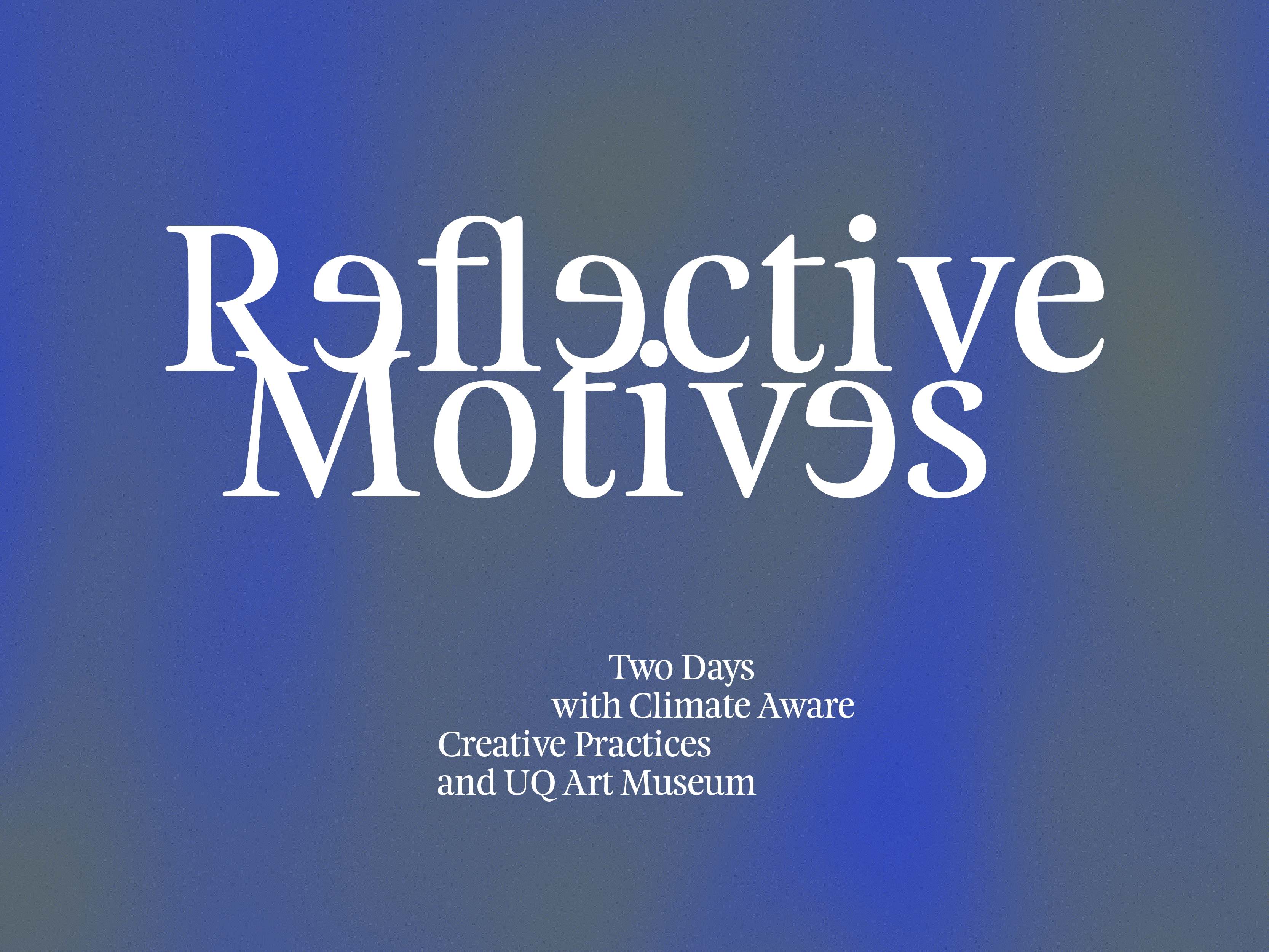
Reflective Motives is a two-day gathering hosted by UQ Art Museum in collaboration with the Climate Aware Creative Practices Network (CACP). The program is made up of four artist-led workshops facilitated by invited artists and researchers: Dominique Chen, Caitlin Franzmann, Libby Harward, Bianca Hester, Eugenia Lim, Bronwyn Bailey-Charteris, Lleah Smith and collaborators to be announced. The keynote conversation will take place between Dr. Aunty Mary Graham and Tristen Harwood. Alongside shared meals, walks and screenings, Marilena Hewitt will collaborate with attendees and facilitators to create a responsive Reflective Motives reader, collating conversations, workshop notes, reflections and printing experiments, in a live publication to be distributed at the event’s close.
Reflective Motives brings together artists, researchers, educators and curators for two days of practice-led climate thinking. Drawing on Dr. Aunty Mary Graham’s articulation of ‘the reflective motive’ as mode of understanding and practicing relationality, this gathering offers strategies for responding to a socially and environmentally changed climate in the context of contemporary art. Reflective Motives is an invitation to engage with artists working with place, Country, matter and language. Alongside hosted workshops and talks, a breakout space will provide room for unprogrammed conversations, sharing, meals, and exchanges, as well as a platform for attendees to self-organise their own creative and collective contributions to the event.
Program Schedule:
Community Picnic Blanket Exchange
As part of Reflective Motives attendees are invited to participate in a community picnic blanket exchange. Get stitching/weaving/patching/printing! In your studio, with friends, collaborators, community groups, or in classrooms, you are invited to create a picnic blanket to bring, use and swap.
Please register to stay up to date, including further details for session registration as some parts of this program will have limited capacity.
Reflective Motives is organised by Therese Keogh and Jacqueline Chlanda with Helen Hughes, Tara McDowell and Terri Bird from the Climate Aware Creative Practices Network
Reflective Motives is hosted by UQ Art Museum in partnership with the Climate Aware Creative Practices Network and is supported by the Australian Government through Creative Australia, its principal arts investment and advisory body, and by Monash Art Design and Architecture.