plants, seeds, memory, and each other: A Conversation with Dominique Chen, Caitlin Franzmann, Libby Harward and Freja Carmichael

Join artists Dominique Chen, Caitlin Franzmann and Libby Harward in conversation with curator Freja Carmichael to reflect on the role of plants in art, culture, community and storytelling. Together, they will consider what plants reveal about place, connections and conditions, the knowledges they sustain, and the ways of relating they invite.
This talk marks the first iteration of Lomandra Network, a long-term research project led by Freja Carmichael at UQ Art Museum, exploring the evolving and interconnected relationships between plants, culture, people, and place.
This talk is presented as part of Reflective Motives: Two Days with UQ Art Museum and the Climate Aware Creative Practices Network. To register your attendance and receive event updates, sign up via the main event page here. For those unable to attend in person, we are offering online livestreaming for all talks. To receive the livestream link, please select "Attend Online" ticket type.
Dominique Chen is a Gamilaraay woman, interdisciplinary artist, researcher, educator, and Senior Lecturer in Art History at the School of Communication and Arts, University of Queensland. Her research spans cultural relational creative practices, socially engaged practice, and Indigenous art and research methodologies, with a particular focus on the intersections between art, agriculture, and care for people and Country. For the past decade, Dominique's practice has centred almost entirely on people and site-specific collaboration—co-designing living artworks and community projects, and developing other relational forms of practice, particularly in remote and regional environments both inside and outside of art galleries and institutions. Her work has been exhibited and presented nationally, including at The Art Gallery of South Australia (AGSA), Nexus Arts, Somerset Regional Art Gallery, The Museum of Brisbane, and at experimental arts festivals Cementa and The Unconformity. Dominique is co-founder, with Quandamooka artist Libby Harward, of The Blak Laundry—a functional pop-up laundromat, living artwork and critical conversation space by and for Indigenous artists.
Caitlin Franzmann is an artist and researcher who creates installations, performances, that explores human relationships to ecological processes and change. In response to the fast pace and sensory overstimulation of contemporary urban life, she invites people to slow down, listen, and contemplate interactions with their surroundings and with other living entities, including plants, insects, fungi, and microorganisms. She creates intimate situations for gathering, sensing, ritual, and storytelling to raise awareness of environmental issues specific to a place. She was a member of feminist art collective LEVEL (2013-2017) and a member of Ensayos (2018-2024), a collective research practice centered on extinction, human geography, coastal health and peatland conservation.
Libby Harward is a Quandamooka (Ngugi) woman from Mulgumpin (Moreton Island) and a contemporary conceptual artist working across installation, performance, video, sound and public art. Her practice interrogates colonial systems of classification, extraction and governance while foregrounding First Nations relationships to Country, knowledge systems and cultural continuity.Harward’s work has been presented nationally and internationally including at the Gallery of Modern Art (Brisbane), Art Gallery of South Australia (Adelaide), ACE Open (Adelaide), Institute of Modern Art (Brisbane), Gropius Bau (Berlin), and Liquid Architecture (Melbourne / Norway). She is the Founder and Creative Director of Munimba-ja Arts Centre, a First Nations-led not-for-profit organisation supporting Aboriginal and Torres Strait Islander artists across South East Queensland through exhibitions, residencies, mentorship and professional development programs.
Dr Freja Carmichael is a Ngugi woman from the Quandamooka people and is Curator at the University of Queensland Art Museum. Over the past 15 years, she has worked alongside First Peoples and communities on exhibitions, programming, collection research, and documentation at art centres, regional galleries, cultural gatherings, contemporary art spaces, and national and international institutions. Freja’s work is dedicated to centring First Peoples’ knowledges, histories, creative practices, and fibre-weaving traditions, and to creating spaces for collaboration, intercultural exchange, and intergenerational sharing through curatorial approaches. Recent curatorial projects include to come together as water, UQ Art Museum (2025); co-curator of The National 4: Australian Art Now, Carriageworks (2023); the national touring exhibition long water: fibre stories (2020–22), Institute of Modern Art; and Weaving the Way (2019), UQ Art Museum. Freja is a member of the Kluge-Ruhe Aboriginal Art Collection Advisory Council at the University of Virginia, United States, and recently completed her PhD at the University of Queensland
About Reflective Motives: Two Days with the Climate Aware Creative Practices Network and UQ Art Museum
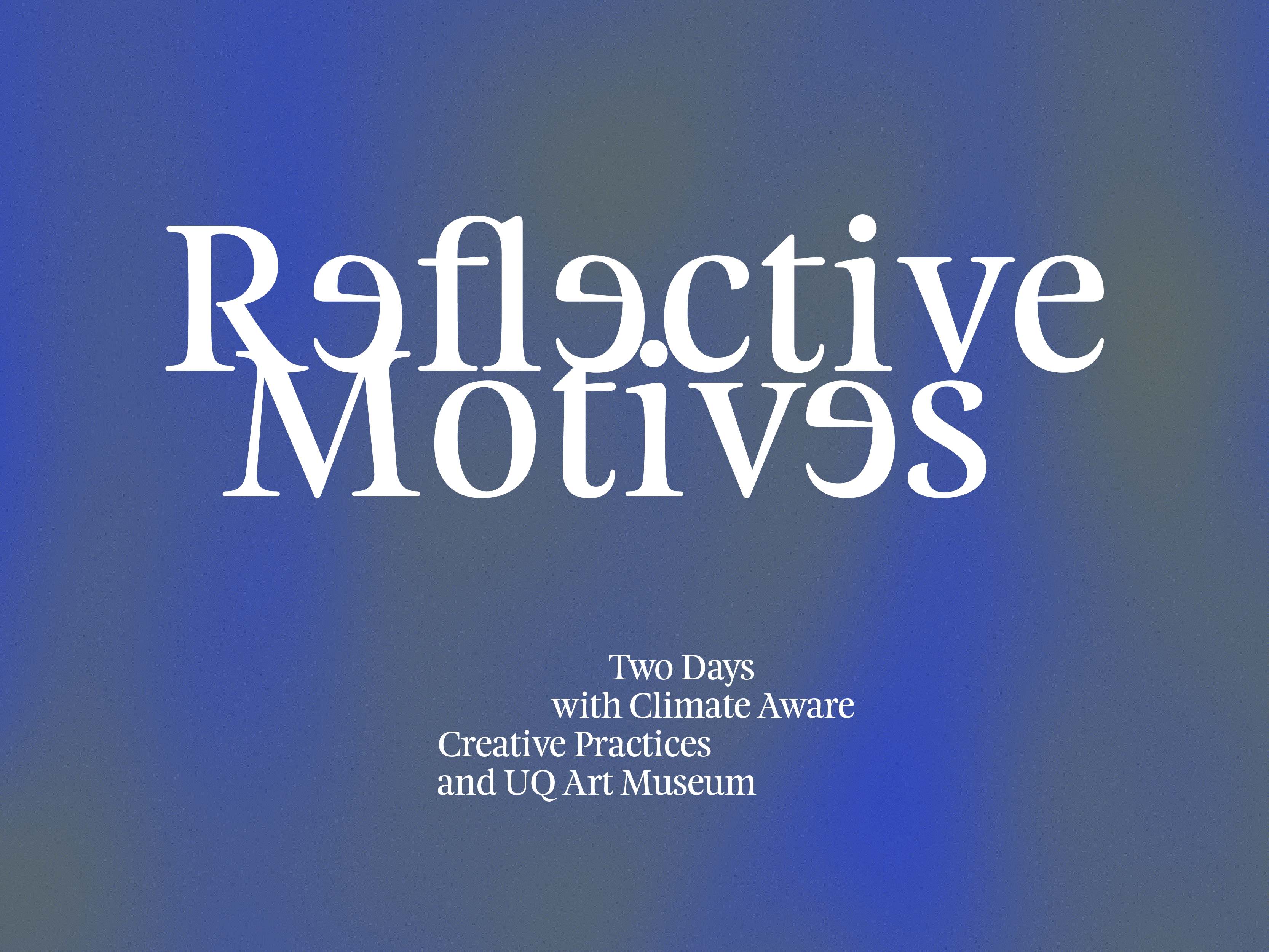
Reflective Motives is a two-day gathering hosted by UQ Art Museum in collaboration with the Climate Aware Creative Practices Network (CACP). The program is made up of four artist-led workshops facilitated by invited artists and researchers: Dominique Chen, Caitlin Franzmann, Libby Harward, Bianca Hester, Eugenia Lim, Bronwyn Bailey-Charteris, Lleah Smith and collaborators to be announced. The keynote conversation will take place between Dr. Aunty Mary Graham and Tristen Harwood. Alongside shared meals, walks and screenings, Marilena Hewitt will collaborate with attendees and facilitators to create a responsive Reflective Motives reader, collating conversations, workshop notes, reflections and printing experiments, in a live publication to be distributed at the event’s close.
Reflective Motives brings together artists, researchers, educators and curators for two days of practice-led climate thinking. Drawing on Dr. Aunty Mary Graham’s articulation of ‘the reflective motive’ as mode of understanding and practicing relationality, this gathering offers strategies for responding to a socially and environmentally changed climate in the context of contemporary art. Reflective Motives is an invitation to engage with artists working with place, Country, matter and language. Alongside hosted workshops and talks, a breakout space will provide room for unprogrammed conversations, sharing, meals, and exchanges, as well as a platform for attendees to self-organise their own creative and collective contributions to the event.
Program Schedule:
Community Picnic Blanket Exchange
As part of Reflective Motives attendees are invited to participate in a community picnic blanket exchange. Get stitching/weaving/patching/printing! In your studio, with friends, collaborators, community groups, or in classrooms, you are invited to create a picnic blanket to bring, use and swap.
Please register to stay up to date, including further details for session registration as some parts of this program will have limited capacity.
Reflective Motives is organised by Therese Keogh and Jacqueline Chlanda with Helen Hughes, Tara McDowell and Terri Bird from the Climate Aware Creative Practices Network
Reflective Motives is hosted by UQ Art Museum in partnership with the Climate Aware Creative Practices Network and is supported by the Australian Government through Creative Australia, its principal arts investment and advisory body, and by Monash Art Design and Architecture.