Climate Pedagogies: A Conversation with the Climate Aware Creative Practices Network
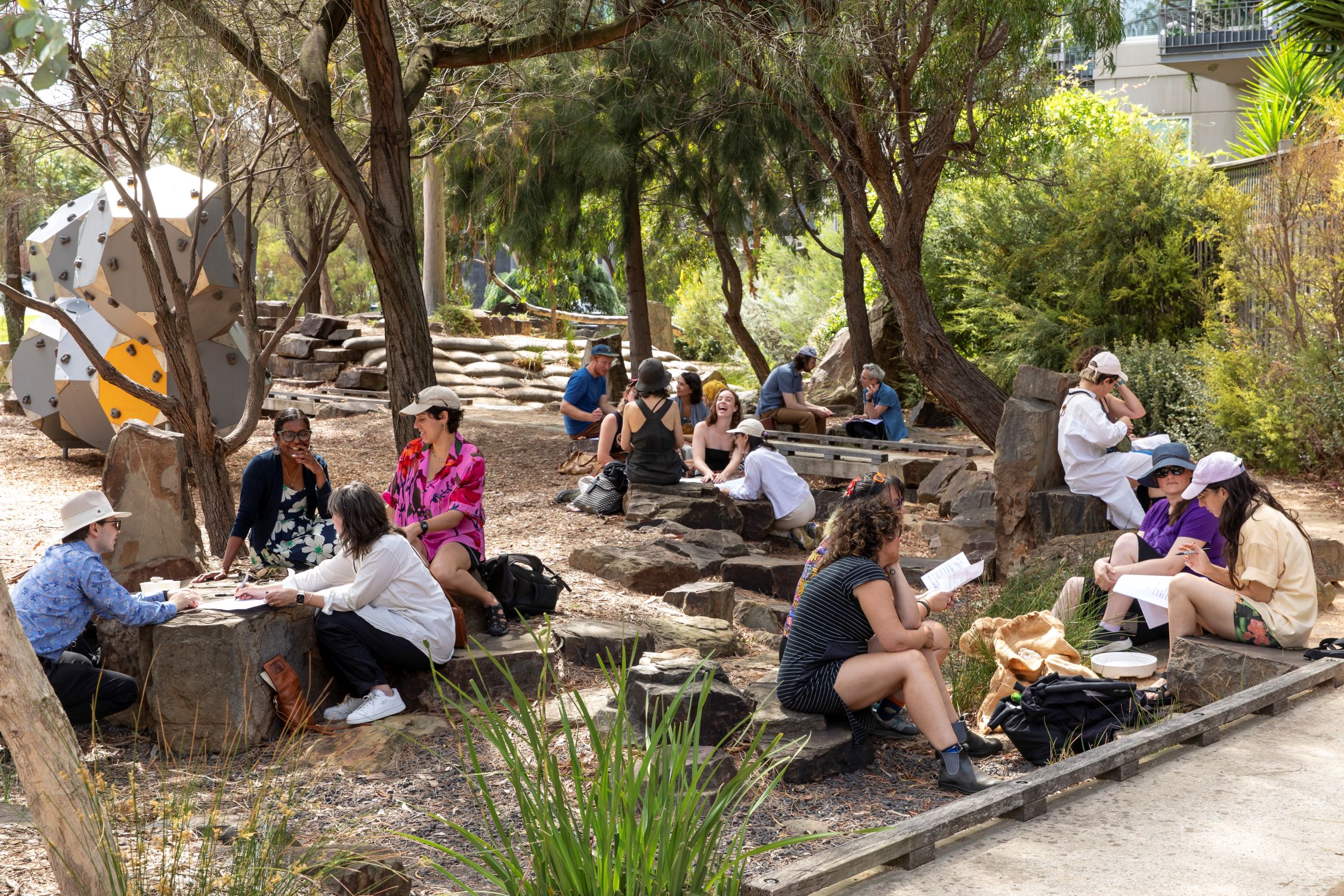
The Climate Aware Creative Practices Network (CACP) is a collective of arts educators, researchers, and practitioners, working across Aboriginal Lands to deepen creative engagement with the challenges posed by climate change in the Australian context. Through online and in-person gatherings, symposia, collaboration, and publication, CACP comes together to share knowledge and strengthen the capacity of art school communities to act, make, and teach ethically through the complexities of the climate crisis.
Join CACP members Terri Bird, Izabela Pluta, Charles Robb, and Bader Rizk, with chair Clare McCracken, for a conversation about the role of creative pedagogies in nurturing place-based, decolonising, and climate responsive practices. Panellists will reflect on their practices as artists and educators, the complexities of material production in creative projects, the role of intergenerational and place-based dialogues in arts learning, and the possibilities of extra-institutional pedagogies that reach beyond universities and into communities, studios, and homes.
Terri Bird is interested in sculptural practices that connect art's material operations to the politics inscribed in place and the environmental consequences of colonial legacies. Since 2003 she has worked collaboratively with Bianca Hester and Scott Mitchell as Open Spatial Workshop, and she is an Associate Professor in Fine Art at Monash University.
Clare McCracken is the Program Manager of the Bachelor of Fine Arts and Photography (Honours), in the School of Art at RMIT University. They are a practising artist, curator, writer, and researcher in the fields of visual art, cultural geography, and cultural theory.
Izabela Pluta is a Polish-born Australian artist whose interdisciplinary practice spans photography, installation, sculpture and moving image. Through field research and material experimentation, she explores migration, environmental change and relationships to place. Her work is exhibited nationally and internationally, and she is an Associate Professor at UNSW Art & Design.
Charles Robb is a contemporary artist based in Meanjin/Brisbane, Australia. His work explores the relationship between memorial objects and incidental forms through sculptural, digital and photographic media. Robb’s work has been seen in numerous group and solo exhibitions at venues including MONA (Hobart), the Museum of Contemporary Art (Sydney), the Ian Potter Centre: NGV Australia (Melbourne). He is currently Associate Professor in Visual Art in the QUT School of Creative Arts, Meanjin/Brisbane.
Bader Rizk is a current PhD candidate undertaking his research at Monash Architecture. With a background in architecture Bader is interested in how violence is experienced on and through architectural spaces, in a paradoxical condition where architecture becomes the agent for military weaponisation whilst also being its victim. Combining architectural and fine arts approaches to visualisation, Bader sees the diagram as a tool for revealing otherwise covert relationships between space, conflict, materials and people, experimenting with the multidisciplinary approaches to visualise these complex systems the diagram, sculpture, model and image become the agents of truth telling.
About Reflective Motives: Two Days with the Climate Aware Creative Practices Network and UQ Art Museum
Reflective Motives is a two-day gathering hosted by UQ Art Museum in collaboration with the Climate Aware Creative Practices Network (CACP). The program is made up of four artist-led workshops facilitated by invited artists and researchers: Dominique Chen, Caitlin Franzmann, Libby Harward, Bianca Hester, Eugenia Lim, Bronwyn Bailey-Charteris, Lleah Smith and collaborators to be announced. The keynote conversation will take place between Dr. Aunty Mary Graham and Tristen Harwood. Alongside shared meals, walks and screenings, Marilena Hewitt will collaborate with attendees and facilitators to create a responsive Reflective Motives reader, collating conversations, workshop notes, reflections and printing experiments, in a live publication to be distributed at the event’s close.
Reflective Motives brings together artists, researchers, educators and curators for two days of practice-led climate thinking. Drawing on Dr. Aunty Mary Graham’s articulation of ‘the reflective motive’ as mode of understanding and practicing relationality, this gathering offers strategies for responding to a socially and environmentally changed climate in the context of contemporary art. Reflective Motives is an invitation to engage with artists working with place, Country, matter and language. Alongside hosted workshops and talks, a breakout space will provide room for unprogrammed conversations, sharing, meals, and exchanges, as well as a platform for attendees to self-organise their own creative and collective contributions to the event.
Program Schedule:
Community Picnic Blanket Exchange
As part of Reflective Motives attendees are invited to participate in a community picnic blanket exchange. Get stitching/weaving/patching/printing! In your studio, with friends, collaborators, community groups, or in classrooms, you are invited to create a picnic blanket to bring, use and swap.
Please register to stay up to date, including further details for session registration as some parts of this program will have limited capacity.
Reflective Motives is organised by Therese Keogh and Jacqueline Chlanda with Helen Hughes, Tara McDowell and Terri Bird from the Climate Aware Creative Practices Network
Reflective Motives is hosted by UQ Art Museum in partnership with the Climate Aware Creative Practices Network and is supported by the Australian Government through Creative Australia, its principal arts investment and advisory body, and by Monash Art Design and Architecture.