Relational Ordering: Reflective Motives Keynote Conversation with Aunty Mary Graham and Tristen Harwood

FREE | 5-7pm | Thursday 12th of November | Dr Mary Mahoney AO Amphitheatre, UQ St Lucia
‘The openness of relational logic extends beyond Oceania,’ so with this we are tide-taken, wind-swept, called upon by history, our ancestors, and answerable to kin, all while our lives are metered by clocks not of our making.[1] We are constituted through relations both destructive and nourishing, structured by colonialism, capitalism, Country, kinship. The very openness of relational ordering calls for critical attention. This is increasingly impressed upon us by the cumulative harm – the devastation of the environmental and cultural realm – endemic to dominant structures of social reproduction, especially as they reach their absolute limits. Such conditions ‘call for the rejuvenation and exercise of relational Aboriginal diplomacy with the coloniser and the wider world’.[2]
– Tristen Harwood
Over decades Dr Aunty Mary Graham has theorised and put forward a relational-ethical order adequate to this task. The relational logic developed in her political philosophy offers both a ground for imaginative possibility and everyday practices that recognise distinctiveness and autonomy as well as nourishing collective life-systems.
Reflective Motives presents Relational Ordering, an in-conversation keynote between Graham and Tristen Harwood, which considers what Graham’s political philosophy asks of us, the possibilities it opens, and forms of collective life it might yet enable.
____________
This is an inclusive, outdoors event at the Dr Mary Mahoney AO Amphitheatre, with live streaming available for those unable to attend in person. Please register to attend. Bring a picnic dinner. While the content of this conversation will be philosophical, art historical and political, children and families are welcome.
[1] Mary Graham and Morgan Brigg, “All Perspectives,” in Politics: Philosophical Ordering by Country (Melbourne: Thames & Hudson Australia, 2026), 164.
[2] Graham and Brigg, “The Centrality of Relating,” 124.
Honorary Professor Aunty Mary Graham is a Kombumerri person through her father’s people of the contemporary Gold Coast, and Waka Waka through her mother’s people. She has taught Aboriginal history, politics, and comparative philosophy at The University of Queensland and other universities. Mary has worked across government agencies and community organisations, including establishing Aboriginal and Islander childcare services during the 1970’s and serving on the boards and committees for many Aboriginal organisations. She served in a range of public positions, including as a regional counsellor for the Aboriginal and Torres Strait Islander Commission and as a Member of the Ethics Council of the National Congress for Australia’s First Peoples.
Tristen Harwood is a Boorloo-born writer of Aboriginal and European heritage who lives on unceded Wurundjeri Country in Naarm, where he lectures at the Victorian College of the Arts. He is a PhD candidate at RMIT, researching the entwined history of Indigenous art and the prison. Tristen is a contributing editor at MeMo and a board member of Gertrude Contemporary. His writing has been published in Memo, The Age, The Saturday Paper, The New York Times Style Magazine, ArtReview, Artlink, Overland Journal, un Magazine, Art Monthly Australasia, Art + Australia, and others.
About Reflective Motives: Two Days with the Climate Aware Creative Practices Network and UQ Art Museum
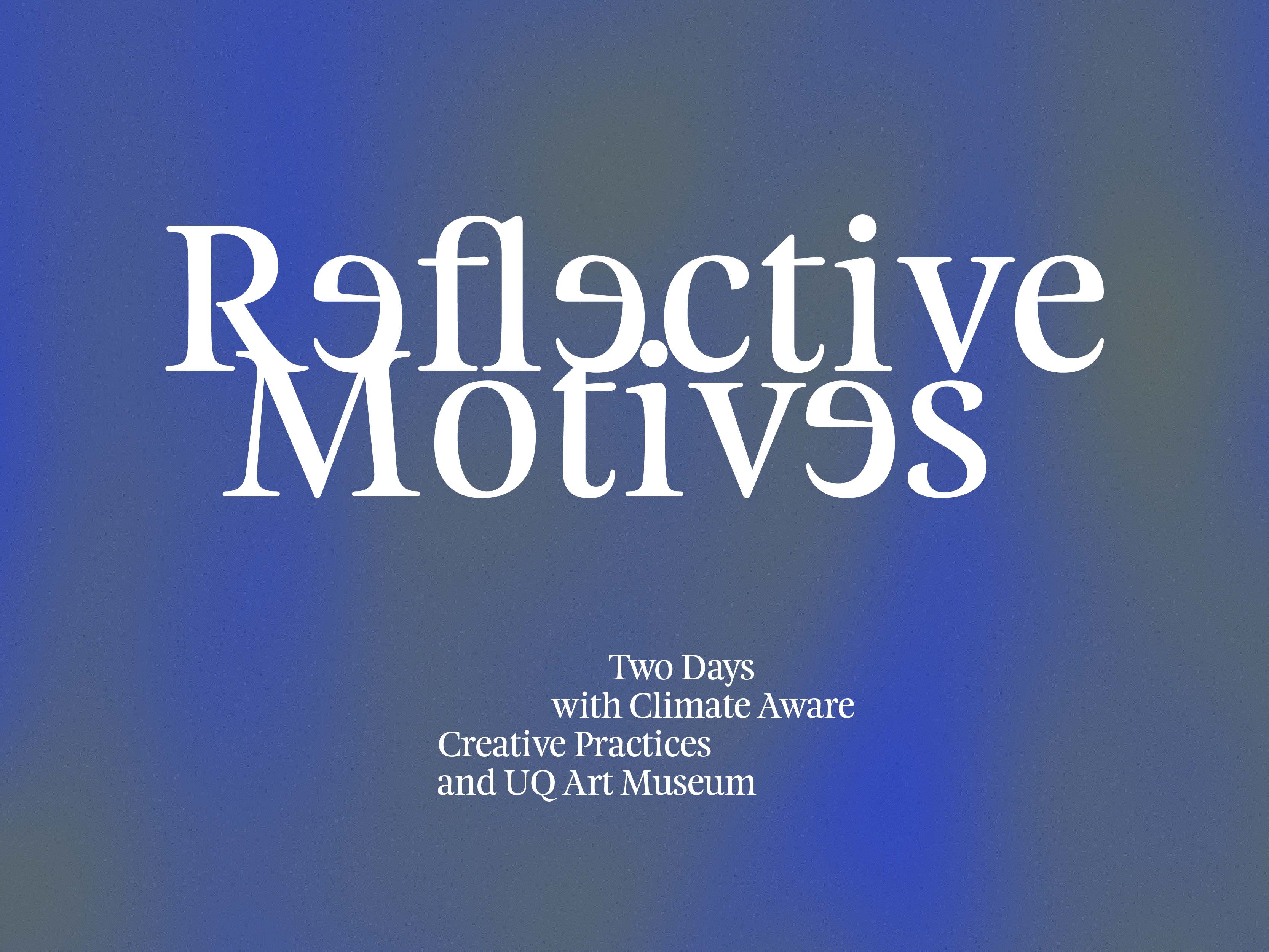
Reflective Motives is a two-day gathering hosted by UQ Art Museum in collaboration with the Climate Aware Creative Practices Network (CACP). The program is made up of four artist-led workshops facilitated by invited artists and researchers: Dominique Chen, Caitlin Franzmann, Libby Harward, Bianca Hester, Eugenia Lim, Bronwyn Bailey-Charteris, Lleah Smith and collaborators to be announced. The keynote conversation will take place between Dr. Aunty Mary Graham and Tristen Harwood. Alongside shared meals, walks and screenings, Marilena Hewitt will collaborate with attendees and facilitators to create a responsive Reflective Motives reader, collating conversations, workshop notes, reflections and printing experiments, in a live publication to be distributed at the event’s close.
Reflective Motives brings together artists, researchers, educators and curators for two days of practice-led climate thinking. Drawing on Dr. Aunty Mary Graham’s articulation of ‘the reflective motive’ as mode of understanding and practicing relationality, this gathering offers strategies for responding to a socially and environmentally changed climate in the context of contemporary art. Reflective Motives is an invitation to engage with artists working with place, Country, matter and language. Alongside hosted workshops and talks, a breakout space will provide room for unprogrammed conversations, sharing, meals, and exchanges, as well as a platform for attendees to self-organise their own creative and collective contributions to the event.
Community Picnic Blanket Exchange
As part of Reflective Motives attendees are invited to participate in a community picnic blanket exchange. Get stitching/weaving/patching/printing! In your studio, with friends, collaborators, community groups, or in classrooms, you are invited to create a picnic blanket to bring, use and swap.
Further details to be released in September, including a full program and social story. Please register to stay up to date, including further details for session registration as some parts of this program will have limited capacity.
Reflective Motives is organised by Therese Keogh and Jacqueline Chlanda with Helen Hughes, Tara McDowell and Terri Bird from the Climate Aware Creative Practices Network
Reflective Motives is hosted by UQ Art Museum in partnership with the Climate Aware Creative Practices Network and is supported by the Australian Government through Creative Australia, its principal arts investment and advisory body, and by Monash Art Design and Architecture.