
UQ Arts Tattoo Trail | St Lucia Block Party 2026
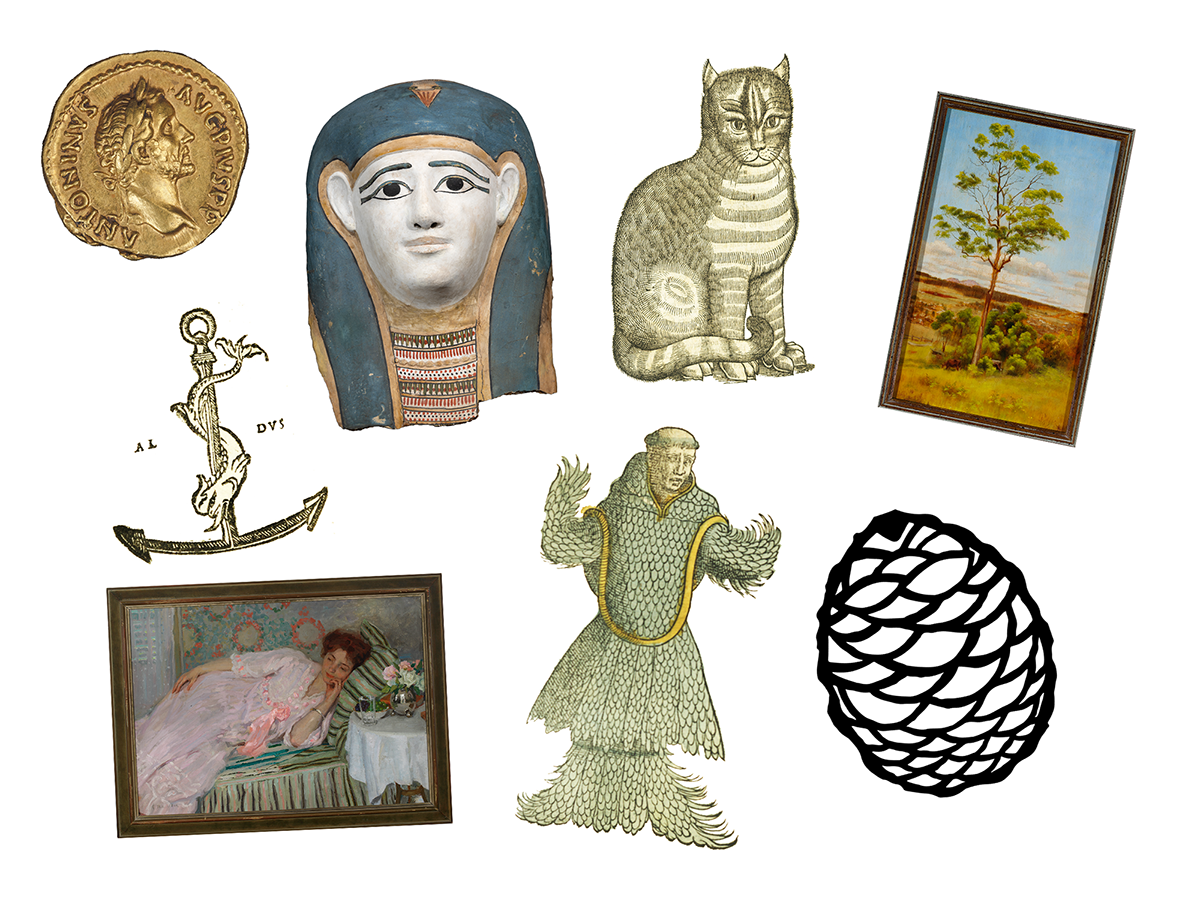
Collect your tattoos inspired by UQ Arts Museums and Collections across 4 locations, beginning at the Great Court. How many can you find?
The trail travels across these four locations - click on each link to navigate their via UQ Maps:
- Great Court - look for the UQ Art Museum staff wearing the Tattoo "Artist" shirts
> our staff can assist you put your tattoos on at this location! - Fryer Library - Level 4, Duhig Tower
- RD Milns Antiquities Museum - Level 2, Michie Building
- Anthropology Museum - Level 1, Michie Building
Or refer the St Lucia Block Party 2026 Schedule + Map to discover more along the trail.
Read about the story behind each temporary tattoo available:
Fryer Library Tattoos:
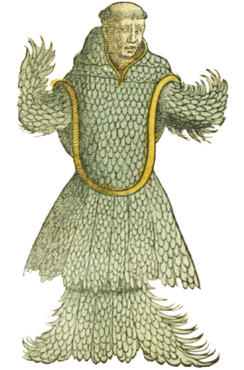
Piscis Monachi (aka The Monkfish)
The monkfish was a sea creature found off the coast of Denmark in 1546. It was described as a "fish" that resembled a human monk in his habit.
The illustration is from the first edition of Pierre Belon’s groundbreaking illustrated study of fish and aquatic animals. Belon’s work is considered to be the greatest single advance in the study of and classification of fish since Aristotle.
From Pierre Belon’s De aquatilibus, libri duo : Cum eiconibus ad vivam ipsorum effigiem, quoad eius fieri potuit, expressis (1553), Fryer Library, Rare Monograph QL614.73 B45
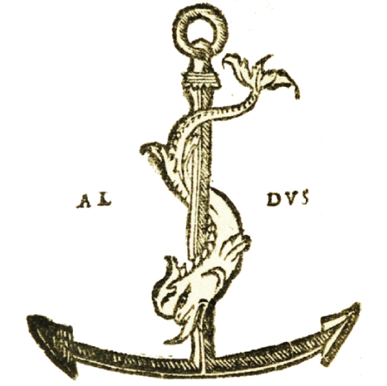 Aldine Press - the anchor and the dolphin.
The Anchor and Dolphin is the printers mark of the Aldine Press. The Press was found by the Italian humanist scholar and teacher Aldus Manutius in Venice in 1494. The Aldine Press is famous in the history of typography, especially for the introduction of italics. It was also the first to introduce the small octavo size printed book called enchiridion, meaning "handbook" which is similar in size to that of a modern paperback. The size was created for portability and ease of reading.
In Ausonius (1517), Fryer Library, Rare Monograph PA6221 .A2
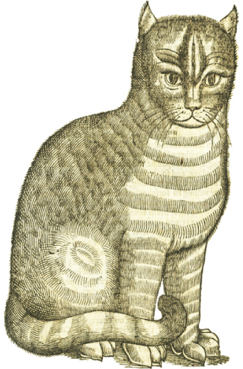 'Topsell's Cat'
The Cat is perhaps the most familiar and popular animal featured in The history of four-footed beasts and serpents. Originally published in 1607, it was combined with Topsell’s The History of Serpents in 1658 and describes both real and fantastic creatures, all illustrated in detailed woodcuts. The book includes familiar animals such as the dog, horse and hedgehog, but also the fantastic, including the Unicorn and the Manticore.
From Edward Topsell’s The history of four-footed beasts and serpents..., (1658), Fryer Library, Rare Quarto QL41 .T68
Anthropology Museum Tattoo
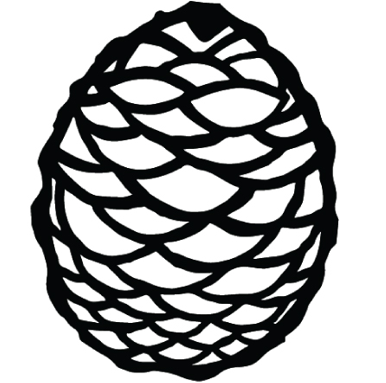 Bonyi by Amanda Pitt-Lythgoe
Amanda Pitt-Lythgoe's design is inspired by the bunya nut (bonyi), a powerful cultural symbol for Kabi Kabi people and other First Nations communities of south-east Queensland. The design celebrates the deep connection between people, Country and the ancient bunya gatherings, where Aboriginal groups came together to share food, culture, stories, trade and ceremony, reinforcing kinship and community ties. Through her contemporary artwork and jewellery, Amanda honours this enduring cultural tradition and the significance of the bunya tree as a symbol of gathering, connection and cultural continuity. Amanda's jewellery designs are displayed and available for purchase at the UQ Anthropology Museum.
RD Milns Antiquities Museum Tattoos:
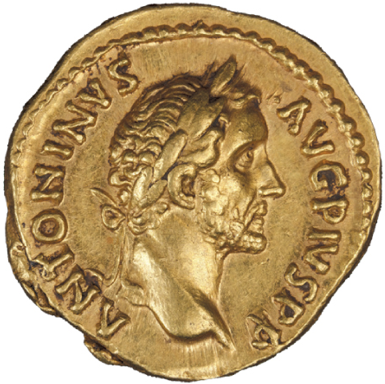 Aureus of Antoninus Pius
Gold, Imperial Roman, 147-148 CE, UQ C.105
Obv: Antoninus Pius, laureate. ANTONINVS AVG. PIVS P.P. Rev: Liberalitas standing, holding abacus in right hand, cornucopiae in left hand. COS.IIII LIB.V The abacus shows that this is measured generosity: the amount of money, corn and other gifts is carefully calculated. The cornucopiae symbolises, in particular, the abundance of wheat in public granaries.
Purchased with funds from Dr B Eckland, Brisbane, 1985.
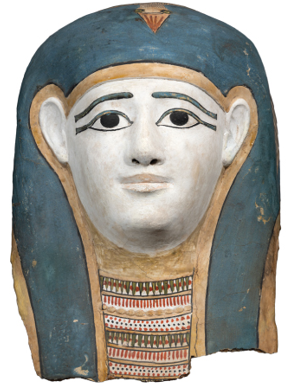 Death-Mask with Mut
Linen, Gesso, Pigment, Late Period Egyptian, 390-340 BCE, UQ 98.001
Lifesize cartonnage mask from a mummy decorated in polychrome over gesso. The wig and details of eyebrows are in blue and the face white with faint traces of pale pink at the mouth. At the neck is a broad collar representing petalled beads and decorated in green, red, white and buff. The principle decoration consists of the vulture sacred to Mut on top of the head, its wings spread and clasping 'Shen' signs in its claws. A small area of damage on the left hand lappet and some minute patches of restoration but generally in good condition.
Purchased from Charles Ede Ltd, London, with funds from Vice-Chancellor John Hay, the Friends of Antiquity, and The Alumni Association of the University of Queensland, 1998. Part of a French Private Collection, c. 1920.
UQ Art Museum Tattoos:
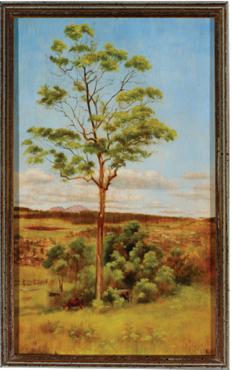 Toowoomba, Queensland 1898
 William Wilson, born 1849 Brisbane, Queensland. Lived and worked Pilton Station, Darling Downs, Queensland; London, England; Toowoomba, Queensland; and Richmond, England until his passing in 1924. Oil on cedar panel. Collection of the University of Queensland, purchased 2003.
William Wilson was the son of a wealthy Scottish settler and worked on Pilton Station, where the Queensland writer Steele Rudd (Arthur Hoey Davis) was also employed as a stockman. Wilson began exhibiting with the Queensland Art Society in 1892. Founded in 1887, the Society played an important role in the development of professional art in Queensland, while opportunities for formal art education were also expanding, including through the appointment of the London-trained artist Godfrey Rivers as Art Master at Brisbane Technical College.
Painted on small cedar panels of a similar size, Wilson’s poetic depictions of well-known sites present the landscape as quiet, distant and unpopulated. The works offer an outsider’s perspective, shaped by an aesthetic appreciation of the landscape rather than an engagement with the people who lived and worked there. In this scene, a tree, bushes and two cows, partially obscure the distant town. The apparent harmony of the landscape gives little indication of the tensions over land use between graziers and small farmers that shaped colonial Queensland. Wilson’s own background as a landowner further complicates any identification with the hardships experienced by rural workers. Equally absent are signs of the region’s original inhabitants, reflecting the way Indigenous presence was often excluded from colonial representations of the landscape.
Nine works by Wilson are held in The University of Queensland Art Collection, which comprises more than 4,400 works, predominantly by Australian artists, dating from the nineteenth century to the present. The collection provides an important record of Queensland’s artistic and cultural history, preserving the work of artists such as Wilson alongside that of more widely recognised Australian artists.
Wilson was painting at a time when Australian artists were increasingly encouraged to look at their own surroundings rather than simply follow European models. Wilson’s work is a significant record of how Queensland’s landscape and in particular Toowoomba as a growing township, was being seen and represented in the late colonial period. Today, the painting allows us to appreciate the beauty of the landscape while also considering the much broader and more complex history behind it.
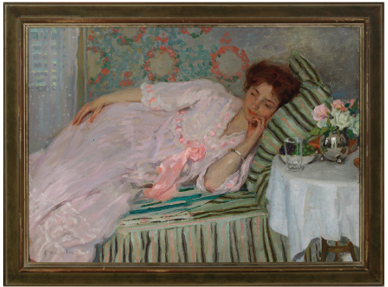
E (Emanuel) Phillips Fox, born 1865 Melbourne, Victoria. Lived and worked Melbourne, Victoria; Paris, France and London, England until his passing in 1915. Oil on canvas. Collection of The University of Queensland, purchased 1955.
E (Emanuel) Phillips Fox was one of Australia’s significant artists of the late nineteenth and early twentieth centuries. He trained at the National Gallery of Victoria School from 1881 to 1886 alongside artists including Rupert Bunny, Frederick McCubbin and Tudor St George Tucker. In 1887, he travelled to Europe, studying at the Académie Julian in Paris and working in artist colonies in Étaples, France, and St Ives, England. His exposure to European art, particularly the intimate domestic scenes of French painters Pierre Bonnard and Édouard Vuillard, had a strong influence on his work.
This influence can be seen in Reclining Figure, where a woman is shown reclining on a chaise longue within an intimate domestic interior. The quiet, contemplative scene reflects the period’s idealised representations of femininity, while Fox’s slightly off-centre composition creates the impression that the viewer has entered the room unexpectedly. His attention to interior decoration, pattern and textiles is evident in the striped upholstery, floral wallpaper and the woman’s elaborate tea gown. Fox carefully captures the different qualities of these fabrics, using colour, pattern and brushwork to suggest their weight, softness and texture.
There are four works by E. Phillips Fox in The University of Queensland Art Collection, two of which form part of the Stuartholme–Behan Collection of Australian Art. This collection of nearly 100 works was permanently loaned to The University of Queensland by Stuartholme School, Bardon, in the early 1990s. It includes important works by some of Australia’s best-known artists, including Arthur Streeton, Charles Conder and Tom Roberts.
The Stuartholme-Behan Collection forms part of the much larger UQ Art Collection, which comprises more than 4,400 artworks, predominantly by Australian artists, dating from the nineteenth century to the present. Together, these works provide a valuable record of the development of Australian art and offer insights into changing ideas about Australian identity, society, landscape and culture. As a university collection, the artworks are also an important resource for teaching and research, allowing students, researchers and the wider community to engage directly with Australia’s artistic history.
Reclining Figure is particularly significant within the UQ Art Collection because it reflects the international influences on Australian art during the late nineteenth and early twentieth centuries. Fox’s training in Australia, followed by his experiences in Europe, demonstrates how Australian artists travelled, encountered new ideas and artistic movements, and incorporated these influences into their own practices.