

As part of its 50th anniversary celebrations, UQ Art Museum has commissioned a new sculptural work by Koa, Kuku Yalanji, Meriam Mer and South Sea Islander artist Keemon Williams. The new work, designed for temporary outdoor exhibition, will be showcased at the upcoming St Lucia Block Party. UQ Art Museum curator Kyle Weise has contributed this essay that explores Williams' new commission.
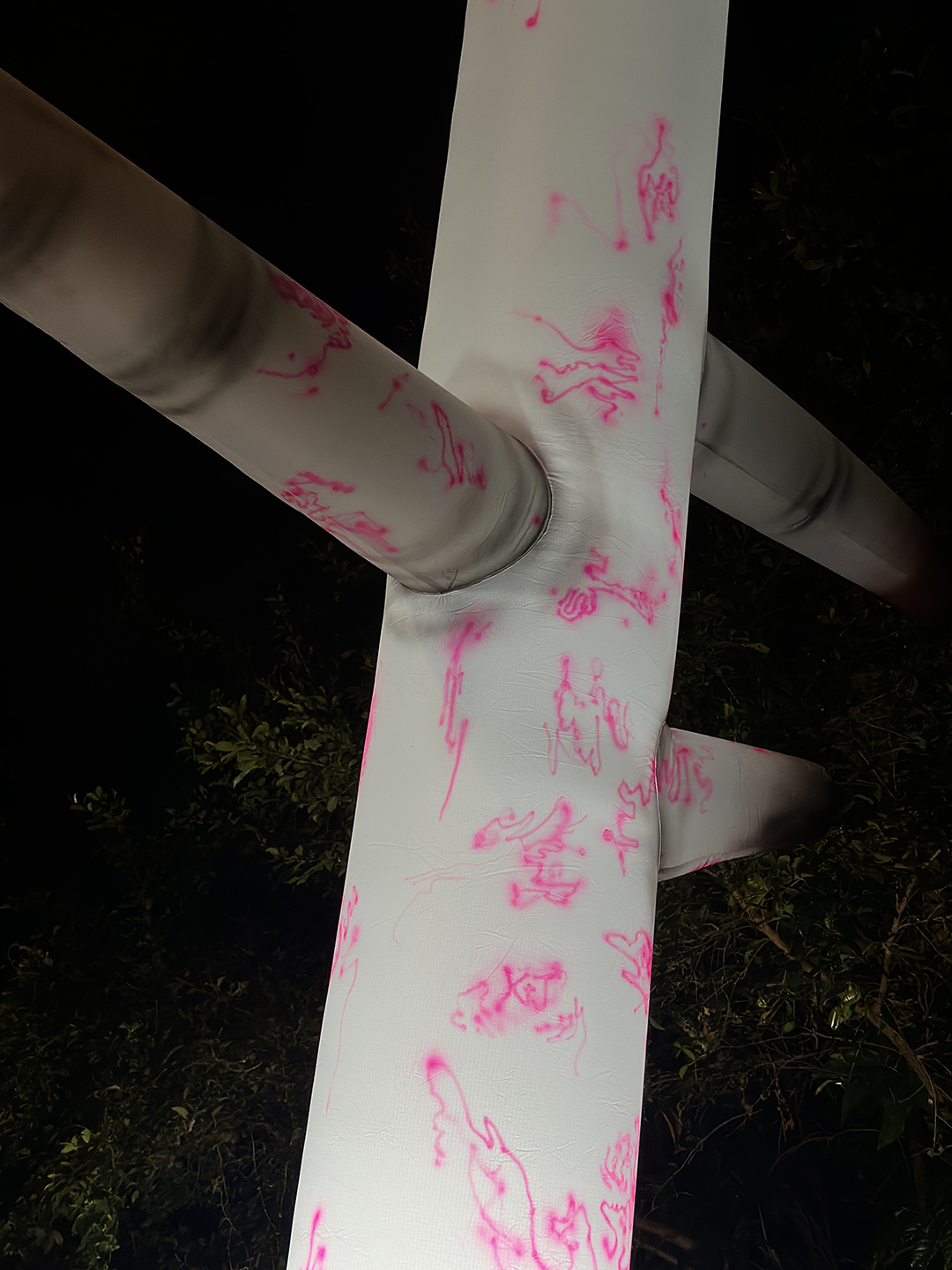
I’m sure we’re taller in another dimension (2026) consists of two custom-made inflatables that suggest the shape and colour of eucalyptus gum trees. Their towering height points to the historical, cultural, and environmental significance of the trees that they mimic. Positioned upright and filled with air by motorised fans at their base, these inflatable forms recall the design of ‘air dancers’: those tubular figures with long arms that are often placed on the roadside to draw attention to retail businesses, with their energetic and silly movement attracting the gaze of people in passing cars.
While the nylon surface of Williams’s inflatables evokes the distinctive white pallor of the ghost gum, it is embellished with bright-pink airbrushed squiggles that recall the textures and marking of a scribbly gum. The reproduction of these tree-like forms within the guise of a marketing tool draws attention to the landscape of this continent as one for sale: an environment leveraged in the service of capitalist consumption. In previous works, Williams has used the form of souvenir-store boomerangs—reconstructed in aluminum, plastic, and ceramic—to emphasise the commodification of Aboriginal culture in developing national identity.[1] Similarly, the gum tree has held an important place in the iconography of national identity, predominantly expressed through landscape paintings.[2]
John Glover (1767–1849) was perhaps the first settler-artist to aesthetically focus on the specificity of the eucalyptus and its contrast to European trees.[3] However, the German émigré Hans Heysen (1877–1968), working a century later, is cited as the key figure in elevating the specificity of the gum tree in Australian landscape painting. Art historian Ian McLean writes, “Heysen hit upon the gnarled gum tree as a national symbol, his paintings caught the imagination of the Australian art world and its public. […] Heysen made his eucalypti a national totem.”[4] For Heysen, the key difference when representing the gum, as compared to European trees, was to focus on the trunk rather than the foliage: “The design of the gum is expressed in the flow of its trunk and limbs.”[5] Certainly, this is the approach we find in Williams’s sculptures: bare of leaves, only the limbs remain, but their reference—the gum tree—is unmistakable. Williams sees I’m taller in another dimension in the context of, and as cognate with, the history of paintings of gum trees. Positioned in conversation with this history, the work acts as an animated landscape painting.
Heysen’s influence in the style and subject of landscape paintings is evident in works in the UQ Art Collection by Penleigh Boyd (1890–1923), Percy Stanhope Hobday (1879–1951), Harold Parker (1873–1962), James Holmyard (1929–2009),[6] and Gunai/Kurnai artist Ronald Bull (1942–1979), among others. Bull is represented in the Collection by the haunting painting Untitled (Landscape) (1974). As a young child, Bull was inspired by Heysen’s work and he would later study informally under the artist.[7] The focus of Untitled (Landscape) is gum trees, alongside their remnants and reflections gathered in and around a waterhole. Standing amid a muted backdrop, the trees are depicted by Bull as ghostly sentinels in a softly faded and foggy landscape: a delicate portrait of these beings. Writing on Bull, art historian Sylvia Kleinert notes that, as he was raised and working under assimilationist policies, European-style landscape painting was a path to his recognition and mainstream acceptance.[8]
For settler Australians, landscape paintings depicting towering gum trees have acted as a symbol of national identity, and have encouraged the commodification of the land through a static and disconnected sense of place. This commodification is naturalised by the placement of horses, cows, and other pastoral incursions, rendered as almost camouflaged and thus co-operative aspects of the painted landscape. This is evident in Heysen’s work as well as in the work of several of his contemporaries in the UQ Art Collection, such as Hubert Jarvis (1882–1964), Lionel Lindsay (1874–1961) and Victor Watt (1886–1970).[9] However, for Bull, this style of landscape painting was an expression and affirmation of his love for place, for Country.[10] In his work, Williams grapples with this complex history of the gum tree in landscape painting, where the form is both revered and colonised.
In Heysen’s paintings, gum trees are often gigantic forms, with storybook-like proportions that lean towards the fantastic and mythical in their overwhelming statuesque stillness.[11] In the mid-twentieth-century, Arrernte artist Albert Namatjira’s (1902–1959) watercolour renderings of the ghost gums of Central Australia would introduce a new style and bring forward immense cultural emphasis on the gum tree as a living icon from an Indigenous perspective. McLean writes: “Namatjira would create an Arrernte version of Heysen’s totemic evocations of Eucalyptus and desert topography that captured the imagination of the Australian public.”[12] While there are some tonal connections to the later watercolours that Heysen produced in the Flinders Ranges, Namatjira’s ghost gums are distinct, and aesthetically and conceptually distant, from Heysen’s. Here, bold white forms are starkly outlined against the contrasting colours of the surrounding site, land, and sky. The ghost gums in Namatjira’s work often move further into the centre of the picture than trees in a typical Western composition, which might treat them simply as a framing device.[13] Namatjira’s ghost gums are alive with what Ian Burn describes as their “slow meandering trunks” that are “merging, wandering serpent like, a giant pathway or incision across the landscape”.[14] As McLean observes, Heysen’s landscapes evoke a lost age, whereas Namatjira’s landscapes are sites of living beings: “Namatjira often insinuated an anthropomorphic energy into his landscapes.”[15] It is this vitality, this bodily and organic connotation, that is emphasised in Williams’s animated inflatable forms.
Namatjira’s work famously combined Arrernte knowledge and identity with Western artistic traditions. During his lifetime, this left Namatjira (like Bull) popular and widely seen, yet relatively unacknowledged by major art museums. Again, McLean is instructive: “Australia failed Namatjira because its national art galleries considered his Western-looking style proof of his art’s inauthenticity, as if it was both fake Aboriginal and fake Western art.”[16] The impossible bind of ‘authenticity’ is one that overtly occupies Williams. Reflecting on his boomerang works, Williams has noted, “So, if you purchase my boomerangs that are deliberately fake, you’re left with a neat little paradox. They’re not ‘real’ looking at all, but they are made by real and very annoyed blak hands.”[17] I’m sure we’re taller in another dimension continues this oscillation between ‘authenticity’ and ‘inauthenticity’, as the work expresses an Indigenous perspective within the language of the commodity, commandeering the materials of a thoroughly commercialised visual culture for its own ends.
Arrernte artists who have subsequently continued to produce works in the tradition of Namatjira’s watercolours have embellished this style in the context of the commodification and exploitation of the landscape. Emblematic here in the UQ Collection are works including Danger – Mining (2016) and Mining on Our Country, NT (2016) by Gloria Napurrurla Pannka (1949–2020) and Mining Is Ruining Our Beautiful Countryside (2016) by Kathleen France Inkamala (b. 1968). The Central Australian landscapes depicted by Pannka and Inkamala place signs and tools of extractive and destructive industries (e.g., a dump truck, signs warning of poison and explosives) alongside prominent ghost gums, which read as adversaries of industry, protecting the landscape. In Williams’s work, as in the work of these Arrernte artists, the gum tree is part of a relational language with Country and a visual symbol that highlights both the exploitation of the landscape and the potential to resist it.
Williams’s temporary, movable synthetic ‘trees’ draw attention to the entanglement of their surrounds within the ongoing processes of the disruption, extraction, and reorganisation of the life and landscape of this continent. Introduced grasses and trees from around the planet sit alongside these inflatable ‘trees’, synthesised from global supply chains. Any twenty-first-century garden in which Williams’s synthetic, electrically powered sculptures are placed is as constructed and introduced to this place as the sculptures; both are equally products of capitalist globalisation. Thrusting themselves into this place, Williams’s large, bright, and noisy sculptural ‘trees’, designed by blak hands, assert not just survival but rather the flourishing of contemporary Indigenous identity against the bounds and manners of the colonial garden-scape.
I’m sure we’re taller in another dimension is closely connected to a computer-animated moving image work by Williams, Who will touch the sky when tomorrow too is stolen? (2025). Here, an animated tube dancer, with markings akin to the inflatables, stands alone, slowly moving in a barren landscape, where it is the only form of ‘life’. The lone inflatable figure alludes to the treatment of this land as being akin to that of a sales-yard: reduced to a place of commerce, to be used, consumed and abandoned. Life-sustaining trees are replaced by a flaccid piece of plastic. Yet, there is also a pathos in this figure, as it tries to stay upright and afloat, keeping a smile in difficult circumstances.
This anthropomorphic element of the air dancers is continued in the commissioned work. The synthetic surface acts like a skin, or a mask, supporting the temporary creation of these figures, as they move from a crumpled pile of fabric to bold characters. They are subject to the whim of forces beyond their control, as they are generated and animated by both ambient wind and the fan at their base. Failure and hope collide as the artificial bodies fight to sustain themselves, with their noisy motors working tirelessly to avoid the skin from crumbling, tumbling to the ground in a wrinkled heap. This noise, and their almost violent, frenetic movement, distinguishes these sculptural forms from the silent, gentle animated figure in Who will touch the sky when tomorrow too is stolen? Indeed, the moments of turning the inflatable sculptures ‘off’ and ‘on’ are not peripheral to the work itself, but are dramatic moments of ascendance and collapse that further anthropomorphises the figures and form an indispensable part of their being.
Significantly, and in contrast to the computer-generated animation that preceded it, I’m sure we’re taller in another dimension adds a second figure: it comprises a non-identical pair. There is an anthropomorphism in these inflatable sculptures that links back to Namatjira and is accentuated by this doubling. Their movements and coupling suggest a pair of dancers, or even lovers. This is further emphasised by the title of the work, which is a lyric from “White Ferrari”, a track on Frank Ocean’s generation-defining album Blonde (2016):
If you think about it, it'll be over in no time
And that's life (Love)
Love (Love)
I'm sure we're taller in another dimension
You say we're small and not worth the mention
You're tired of movin', your body's achin'
We could vacay, there's places to go
Clearly, this isn't all that there is […]
But we're so okay here (We're fine), we're doing fine (We're fine)
“White Ferrari” is a melancholy ode to a love that once-was, holding on to its final moments and remembering this:
I care for you still, and I will forever
That was my part of the deal, honest
We got so familiar
Spending each day of the year
White Ferrari, good times
The bright-pink airbrushed scribbles, drawn by Williams onto the surface of the figures, oscillate between hard lines and soft ethereal forms and add a playful element to the work. There is a mimetic element to this, recreating the distinctive abstract lines made by insects on the bark of the scribbly gum. But the airbrushed rendering of these lines also gestures toward the way that this tree, with its soft surface amenable to engraving, becomes a forum for human scribbles and marks: a place where love, confessions, and limerence are inscribed in initials and symbols ( 4 EVA). I’m sure we’re taller in another dimension contends with the reality of an exploited landscape for sale and the collusion of colonial landscape paintings within this. However, alongside this is playfulness and an embrace of possibility, as we try to make sense of, assert ourselves in, and leave a mark on, the circumstances in which we are placed.
Kyle Weise is a Curator at University of Queensland Art Museum.
Keemon Williams is a Koa, Kuku Yalanji, Meriam Mer and South Sea Islander artist whose work grapples with contemporary Indigenous identity in the context of hyper-consumption.


