
Old Words, Finding New Places: First languages in creative practices panel
Old Words, Finding New Places: First languages in creative practices panel
Venue
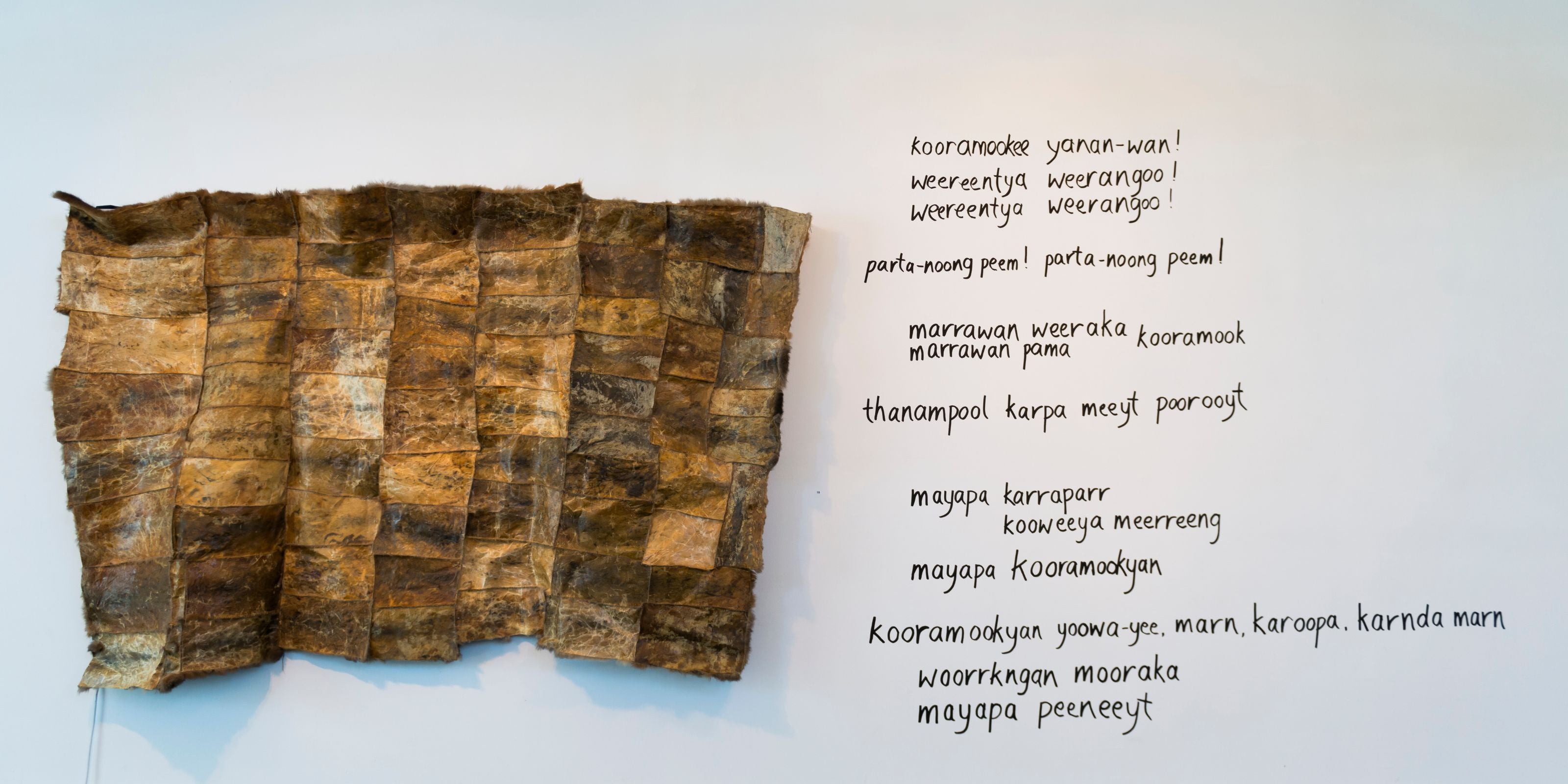
Aboriginal and Torres Strait Islander languages sustain living connections to Country, lands, waters, skies and place across generations. The continuation and strengthening of first languages are vital for culture, identity and community, carrying knowledge forward for future generations.
Bringing together Indigenous peoples, including Elders and artists from diverse language groups and creative practices, this collective conversation celebrates and explores how old words are finding new places and resonance within contemporary Indigenous creative practices.
Join us and hear from Ngugi artist Elisa Jane Carmichael, Gunditjmara artist Dr Vicki Couzens, Gurindji/Malngin artist Leah Leaman, Gamilaraay/Wailwan and Biripi artist r e a and led by Pakana Curator Dr Zoe Rimmer for the first in a series of public conversations highlighting the embodiment, activation and renewed presence of First Nations languages.
This panel is presented in partnership with the School of Languages and Cultures and is funded by the Australian Research Council (ARC) Laureate Fellowship Kathleen Fitzpatrick Award (FL250100115). It is the result of an ongoing collaboration between Professor Felicity Meakins (School of Languages and Cultures), Ocean Pathways Education Producer Logan Bobongie and Curator Freja Carmichael (both UQ Art Museum).
More information about what to expect on the day, including detailed wayfinding and directions, is available here as a visual story.
Speaker Bios:
Elisa Jane Carmichael is a Ngugi woman of the Quandamooka People (Moreton Island/Mulgumpin and North Stradbroke Island/Minjerribah, Queensland). Elisa has a Bachelor of Fine Arts, Queensland College of Art, Griffith University; and a Master of Fine Arts, QUT.
As an artist, her practice draws on Ancestral knowledge, matrilineal connections, memories of place and relationships with Country. Elisa and her mother, Sonja, have collaboratively been at the forefront of gathering knowledge, learning, and experimenting, to revitalise the unique traditional practice of Quandamooka weaving and explore its creative applications to contemporary fibre art. Elisa further develops her practice through both new techniques and materials, acknowledging, nurturing, and protecting her culture and the resources of Quandamooka Country. Her regular inclusion in national survey exhibitions and major prizes demonstrates her conceptual explorations through weaving, sculptural materials, cyanotypes and now printmaking.
Associate Professor Dr Vicki Couzens is a Keerray Woorroong/Gunditjmara woman whose four-decade+ career weaves together academic leadership and creative cultural expression.
Vicki is the Chairperson of the Victorian Aboriginal Corporation for Languages, VACL; the state peak organisation for First Nations language reclamation and revitalisation. VACL has been established since 1994 and continues its work from offices in Docklands.
At RMIT University, she is Lead of Yoonggama, the First Nations Transdisciplinary Research Cohort she co‑designed to forge sovereign, self‑determined, Country‑led approaches to knowledge creation and Indigenous language revitalisation. A respected ARC DECRA Fellow, her research advances revitalisation of Maar languages through Indigenous methodologies grounded in relationality, yarning, and land-based learning.
Vicki is also a Senior Knowledge Custodian for the Possum Skin Cloak Story, renowned nationally for her pivotal role in revitalising possum skin cloak making across south‑eastern Australia. Her multidisciplinary creative practice spans public art, mixed media, performance, and community-based cultural renewal, all oriented toward cultural sovereignty and intergenerational knowledge transfer. Together, her academic and creative work enact a living legacy of language, culture, and Country.
Leah Leaman is a Gurindji/Malngin woman, artist and Chair of the Board of Directors of Karungkarni Art. She works for NT Government Department of Families. Leah takes a pivotal role in many Karungkarni Art projects including the ‘Magneto-reception in Gurindji people’ project which informed the Wanyjika-warla book (in collaboration with Professor Joe Kirschvink and other researchers from Caltech in Los Angeles).
r e a (they/them) is a non-binary artist from the Gamilaraay/Wailwan and Biripi peoples of NSW, they currently live and work between the Warrumbungle’s (Gamilaraay NSW) & Naarm (Melbourne). They are currently working on mapping their family linage and languages in their Postdoc (Indigenous) Fellowship, in the Faculty of Arts, University of Melbourne. r e a is an experimental interdisciplinary artist / curator / activist / researcher/ cultural educator and creative thinker. Their creative practise-led research extends over three decades; their art often focuses on unveiling the silence of the colonial archive. Their creative research extends into the reclamation and reframing of the bla(c)k queer body, as they re-story Indigeneity and bla(c)kness! Their extensive research includes the examination of contemporary discourses, which as yet have not changed the colonial narrative of Aboriginality. r e a’s work is centred in the visual arts and located in experimental digital technologies that intentionally, disrupt and disturb a history of silence. Their art consciously draws on a legacy of lived experiences, ancestral knowledge and the impact of intergenerational trauma, grief and loss. ‘My art is the practice of reclamation; a disruption of the colonial gaze through re-storying the blak-body as a point of protest.’ See link (https://acca.melbourne/exhibition/r-e-a-c-l-a-i-m-e-d/) to recent survey exhibition – r e a : c l a i m e d at The Australia Centre for Contemporary Art, Naarm/Melbourne.
Dr Zoe Rimmer is a proud Pakana woman, cultural historian, curator and creative practitioner, and currently serves as Principal Curator, First Nations Cultures at Queensland Museum. With more than 20 years' experience in museums and cultural heritage, her work focuses on First Nations storytelling, repatriation, cultural revival and community-led museum practice. Dr Rimmer is a recipient of both the Winston Churchill Fellowship and the John Mulvaney Fellowship, and is recognised for her leadership in advancing First Peoples perspectives across public space and cultural institutions.